AI-Driven Market Structure
Intelligence for Digital Assets
OBLX is not a prediction engine. It is the foundational infrastructure for financial AI—verified through a rigorous 5-year public open test in Seoul, the global epicenter of semiconductor and AI innovation.
뉴욕 월가 트레이더의 25년 직관을 디지털화하다: 25,000건의 라벨링 데이터로 증명된 고신뢰도 금융 데이터셋
The Mind Behind the Data

Brian Kim 브라이언 김
Former Wall Street Trader
25+ Years at National Securities & Euro Pacific Capital, New York
Expert-Led, AI-Reflected
인간의 직관이 분석을 주도하고, AI는 이를 데이터 규격으로 기록하고 과거 패턴과 대조한다.
Human intuition drives every structural diagnosis. AI then records it as a standardized data specification and cross-references it against 25,000+ historical patterns—not to replace judgment, but to enforce consistency and create an auditable, machine-readable ground truth.
In South Korea—a global leader in AI, semiconductors, and advanced technology—our dataset has undergone half a decade of real-time public validation on Seoul’s premier financial networks. Every structural diagnosis, every wave count, every invalidation level was published before the market moved, creating an immutable track record of 25,000+ precision-labeled records now ready for global institutional deployment.
Each record contains structural diagnosis, invalidation level, and timestamp
Real-time subscribers across Seoul Economic TV and digital platforms
Users retained over 12+ months, benchmarking institutional-grade trust
Uninterrupted public validation on South Korea's premier financial networks
Capturing the $264B Digital Asset Infrastructure
2030년까지 2,640억 달러 규모로 성장이 예상되는 디지털 자산 인프라 시장에서, 전 세계 5억 8천만 명 이상의 암호화폐 보유자 중 대다수는 여전히 감정적 직관이나 단편적 지표에 의존하고 있습니다. 기관급 구조 분석 도구에 대한 수요는 폭발적으로 증가하고 있으나, 이를 충족하는 솔루션은 사실상 부재합니다.
OBLX는 이 거대한 간극을 메웁니다. 단순 기술 지표의 나열을 넘어, 월가 30년 기관투자 경력을 가진 브라이언 김이 직접 정제하고 검증한 고신뢰도 구조 라벨링 데이터를 기반으로, 리테일 트레이더에게 기관 수준의 시장 구조 분석 역량을 제공합니다.
리테일 트레이더의 87%가 체계적 구조 분석 없이 매매하며, 이 중 72%가 1년 내 원금의 50% 이상을 잃습니다.
기관 투자자들이 사용하는 구조적 분석 프레임워크는 존재하지만, 리테일 시장에 접근 가능한 형태로 제공되는 솔루션은 전무합니다.
30년간 축적된 기관급 분석 로직을 AI 엔진에 이식하여, 모든 참여자에게 동일한 수준의 구조적 정밀도를 민주화합니다.
Why Bitcoin Is the Purest Structural Laboratory
"Bitcoin is the only market in the world where no central bank intervenes, no government manipulates supply, and no corporate earnings distort price action. It is a pure mirror of collective human psychology."
Traditional markets are contaminated. Central bank rate decisions, quantitative easing programs, government fiscal interventions, insider trading, and institutional dark pool activity inject variables that no structural model can fully account for. Every time the Federal Reserve announces an emergency rate cut or the ECB expands its asset purchase program, decades of technical patterns are rendered unreliable overnight. The signal-to-noise ratio in equity markets, forex, and bond markets is fundamentally compromised by these external forces.
Bitcoin operates under an entirely different regime. Its supply schedule is algorithmically fixed and immutable -- 21 million coins, no exceptions. There is no CEO issuing forward guidance, no board of directors authorizing share buybacks, no central authority that can print more supply to suppress volatility. When Bitcoin moves, it moves because millions of independent participants collectively express their fear, greed, euphoria, and capitulation through price action. This makes Bitcoin the most structurally honest market in human history.
This is precisely why Elliott Wave analysis -- a methodology built on the premise that markets move in fractal patterns driven by mass psychology -- achieves its highest fidelity in Bitcoin. In markets polluted by external intervention, wave structures constantly break down as artificial forces override natural crowd behavior. In Bitcoin, wave structures complete with remarkable consistency because there is nothing to override them. The crowd speaks, and the chart listens.
Structural Purity Index: Why Bitcoin Outperforms All Other Markets for Wave Analysis
No central authority, fixed supply, pure crowd psychology
OPEC supply manipulation, central bank reserve purchases
Fed put, earnings manipulation, share buyback distortion
Direct central bank intervention, political pressure
Yield curve control, QE asset purchases, fiscal policy
The implication for AI is profound. When training machine learning models on financial data, the quality of the ground truth is everything. A model trained on structurally contaminated data -- where patterns break unpredictably due to external intervention -- will produce unreliable outputs regardless of architectural sophistication. OBLX solves this by anchoring its entire dataset in the structurally purest market available: Bitcoin. The result is a training corpus with exceptionally high pattern completion rates, providing AI models with the clean, consistent ground truth they need to generalize effectively across market conditions.
The 4-Lens Cross-Verification Protocol
OBLX does not rely on a single indicator, a single timeframe, or a single methodology. Every data label in the OBLX dataset is the product of a rigorous 4-lens convergence protocol. A signal must pass through all four independent analytical lenses before it is classified as verified. This is what separates institutional-grade ground truth from retail-grade guesswork.
All 4 lenses must converge. Any single lens divergence triggers a HOLD or INVALIDATION signal.
Lens 1: Structural Analysis
Elliott Wave + Fibonacci Confluence
The foundational layer. Brian Kim identifies the precise wave count at every degree of trend -- from Grand Supercycle down to Minuette. Each wave must satisfy strict rules: Wave 3 is never the shortest impulse wave, Wave 4 never enters the price territory of Wave 1, and Wave 2 never retraces beyond the origin of Wave 1. Fibonacci ratios are then applied to validate proportionality: Wave 3 typically extends 1.618x Wave 1, Wave 5 often equals Wave 1, and corrective waves retrace to 0.382 or 0.618 of the prior impulse. Only when the wave count and the Fibonacci geometry align does the structural signal pass.
Lens 2: On-Chain Intelligence
Blockchain-Native Behavioral Metrics
Bitcoin's transparent blockchain provides a behavioral intelligence layer unavailable in any traditional market. OBLX cross-references structural signals against on-chain metrics including: UTXO age distribution (detecting long-term holder accumulation or distribution), exchange inflow/outflow ratios (measuring institutional positioning), MVRV Z-Score (identifying overvaluation or undervaluation relative to realized price), and funding rate divergence across perpetual futures markets. When the structural model suggests an Intermediate Wave 3 is beginning, on-chain data must confirm that long-term holders are accumulating, exchange reserves are declining, and leverage is not at extreme levels. Disagreement between structure and on-chain triggers a hold signal, not a trade signal.
Lens 3: Macro Regime Mapping
Global Liquidity + Correlation Analysis
Even in a structurally pure market, Bitcoin does not exist in a vacuum. OBLX's third lens maps the global macro regime to assess whether external conditions support or threaten the structural thesis. Key variables include: the DXY (US Dollar Index) trend -- a strong dollar historically compresses Bitcoin's upside; the M2 global money supply trajectory -- Bitcoin's major bull cycles have coincided with expansionary monetary regimes; real yield differentials across G7 economies -- rising real yields create opportunity cost pressure on non-yielding assets; and the VIX (volatility index) regime -- extreme fear spikes in traditional markets can trigger forced liquidation cascades in crypto. The structural model defines what Bitcoin should do; the macro lens determines whether the environment allows it to happen.
Lens 4: Technical Momentum
Multi-Timeframe Convergence Indicators
The final lens applies classical technical indicators as a timing and execution layer. This is not about using RSI or MACD in isolation -- it is about measuring momentum convergence across multiple timeframes to confirm the structural turning point. OBLX monitors: weekly RSI divergence (bullish divergence at Wave 2/4 lows, bearish divergence at Wave 3/5 highs), daily MACD histogram zero-line crossovers for trend confirmation, volume profile analysis to identify high-volume nodes that act as structural support/resistance, and Bollinger Band width compression to detect pre-breakout conditions. A structural Wave 4 completion signal is only confirmed when momentum indicators across the weekly, daily, and 4-hour timeframes simultaneously align.
4/4 CONVERGENCE = VERIFIED LABEL
When all four lenses independently confirm the same structural thesis -- the wave count is valid, on-chain metrics align, macro conditions are supportive, and momentum is converging -- the signal receives a verified classification. This 4-way convergence is what produces the extraordinary verification rate across the OBLX dataset. It is not a single genius call; it is a systematic, repeatable, auditable process.
ANY LENS DIVERGENCE = HOLD / INVALIDATE
If any single lens disagrees -- for example, the structure suggests Wave 5 completion, but on-chain shows aggressive accumulation rather than distribution -- the signal is held or invalidated entirely. This conservative approach means OBLX occasionally misses short-term moves, but it ensures that every labeled event in the dataset represents genuine structural confirmation, not speculative interpretation.
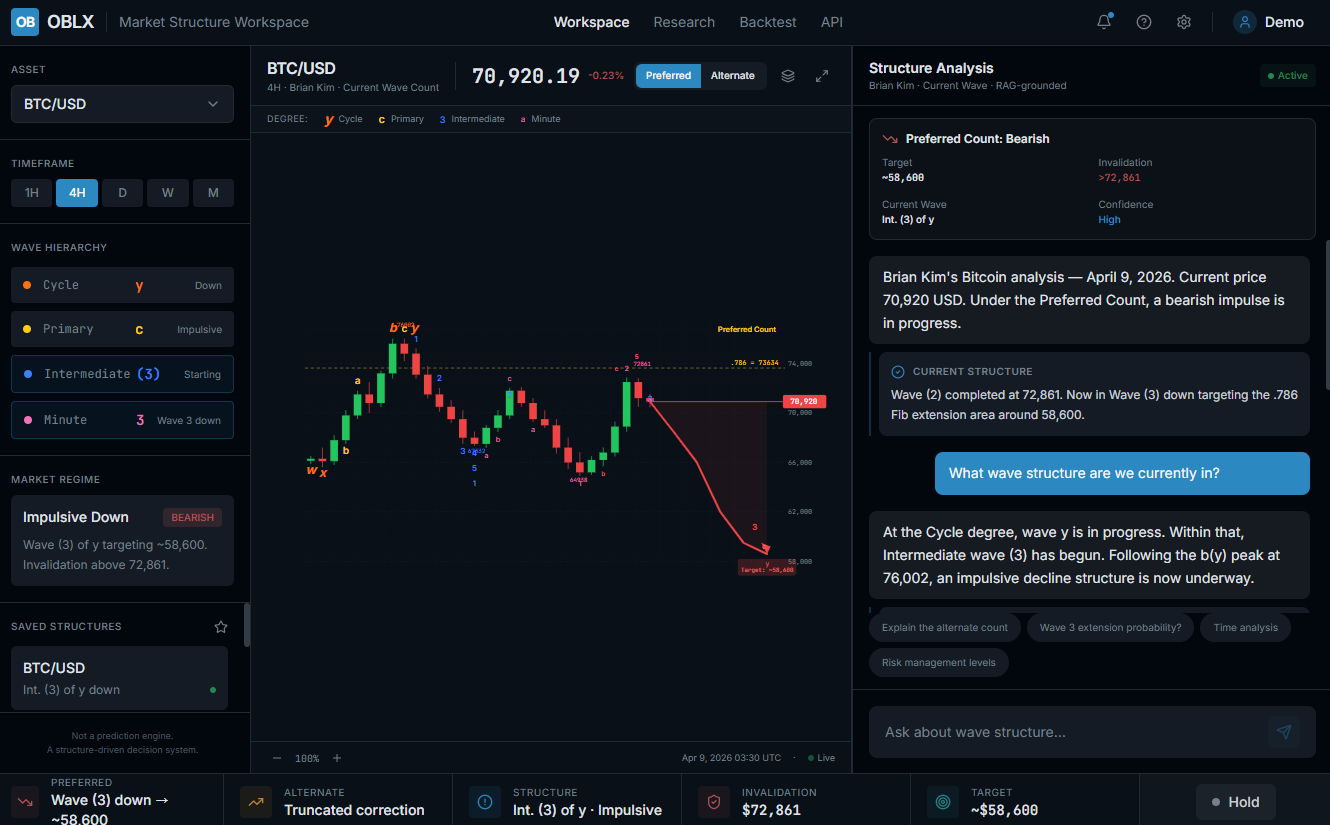
Advanced Wave Count Analysis
Experience the power of 30 years of Wall Street expertise combined with cutting-edge AI. Our proprietary algorithm identifies Elliott Wave patterns with institutional-grade accuracy.
- Target price and invalidation level — derived from wave structure, not guesswork
- RAG-powered pattern matching — current structure cross-referenced against 25,000+ historical wave records
- Ask in any language — Korean, English, and multilingual Q&A for instant structural interpretation
Strategic Vision: The Path to Intelligence
A three-stage strategy to transform expert intuition into institutional-grade digital asset intelligence infrastructure.
Image to Intelligence
25,000 precision analysis charts transformed into AI-ready vector data. Brian Kim’s decades of expertise distilled into a high-density source dataset.
Brian Kim의 노하우가 정제된 고밀도 원천 데이터셋. 25,000건의 정밀 분석 차트 → AI-ready 벡터 데이터.
IP Standardization
Beyond subjective analysis: codifying Invalidation rules, Fibonacci ratios, and Pattern Confluence into a Global Standard IP. The 11-stage color spectrum serves as a visual identification aid within this rigorous specification.
무효화 규칙, 피보나치 비율, 패턴 컨플루언스를 규격화한 Global Standard IP. 11단계 컬러표는 식별 편의용 도구.
Global Scaling
Finance’s ImageNet moment: a B2B API delivering standardized market structure data to quants, hedge funds, and institutions worldwide.
금융의 ImageNet → 전 세계 퀄트, 헤지펀드, 기관을 위한 B2B API 인프라.
The OBLX™ Dataset
Each data point is metadata-tagged with 11 standardized cycle degrees — a rigorous data tagging specification enabling AI to learn recursive market fractals. A pure metadata dataset of 25,000+ records, manually labeled with zero robotic intervention.
로봇의 개입 없이 전문가의 일관된 기준으로 수동 라벨링된 25,000건 이상의 순수 메타데이터셋
OBLX Spectral Standard
11-Stage Standardized Data Tagging Specification
Hover over any bar to explore. Each degree contains the same 5-3 impulse-corrective structure, nested recursively across all time scales.
> Each label represents a verified market structure event, manually tagged with zero-tolerance precision from 5+ years of continuous broadcast data.
> Unlike retail-grade labels, every OBLX data point meets institutional standards with sub-tick accuracy, eliminating the noise that degrades AI model performance.
> Each data point is metadata-tagged with 11 standardized cycle degrees, enabling AI to learn recursive market fractals through color-coded structural taxonomy.
> Every pattern call is publicly archived via Seoul Economic TV broadcasts over 5 consecutive years, providing an unprecedented level of third-party verification for training data.
Deployment Options
Seamless Integration via REST API, JSON/CSV Metadata Export, and Snowflake/BigQuery Data Sharing.
Response, Not Prediction
Every structural thesis is accompanied by a pre-defined invalidation level—the exact price point at which the thesis is wrong, not merely under pressure. This transforms opinion into engineering.
“Textbook structural alignments are rare in live markets. Achieving the 'Right Look' in wave geometry is the fundamental standard for OBLX structural verification.”
교과서적인 파동의 위치는 흔치 않습니다. 그렇기에 파동의 사이즈와 비율은 나의 기준인 'Right Look'을 반드시 충족해야 합니다.
Conditional Thesis
Every OBLX structural diagnosis is framed as a falsifiable conditional statement. Not "BTC will reach $150K," but "If Wave 3 of Intermediate degree is underway, the target range is $135K–$150K, with invalidation at $58,200." The thesis is bounded from inception.
Invalidation levels are derived directly from Elliott Wave structural rules, not arbitrary support lines or round numbers.
Immediate Acknowledgment
When price breaches the pre-defined invalidation level, the thesis is declared invalid on-air, in public, within hours. No goalpost shifting, no silent target adjustment. The alternate count—pre-analyzed and standing by—is activated automatically.
5 years of weekly broadcasts on Seoul Economic TV. Every invalidation, every alternate count activation is publicly archived.
Precise Risk Architecture
Every structural thesis defines three quantifiable parameters: the invalidation price (exact level to the tick), the risk magnitude (percentage from current price to invalidation), and the reward-to-risk ratio. Institutional portfolio managers can plug these directly into position-sizing models.
For each primary thesis, OBLX maps a cascade of invalidation scenarios—maximum drawdown if all counts fail.
Maximum AI Value: Binary Truth
Every label in the OBLX dataset carries a binary outcome: the structural thesis was either validated (price reached the target zone before hitting invalidation) or invalidated (price breached the invalidation level). This clean, binary ground truth is exactly what supervised learning models need.
25,000+ labels, each with a definitive TRUE or FALSE outcome. No retroactive redefinition.
The 2021 Crash: Structural Verification in Real-Time
The definitive test of any analytical framework is not how it performs in hindsight -- it is how it performs in real-time, under extreme pressure, with real money at stake. The 2021 Bitcoin crash from $64,895 to $29,278 provides a publicly documented, broadcast-verified case study of OBLX structural analysis in action.
Brian Kim identifies the completion of Primary Wave 3 on Seoul Economic TV. The structural model signals that the move from $3,858 (March 2020 low) to $64,895 constitutes a complete 5-wave impulse at the Intermediate degree within Primary Wave 3. The 4-lens protocol confirms: structure complete, on-chain showing long-term holder distribution beginning, macro showing DXY reversal underway, momentum divergence present on the weekly RSI.
Bitcoin collapses from $64,895 to $30,000 in 35 days -- a 53% drawdown that liquidates $12 billion in leveraged positions. The market consensus is that Bitcoin is entering a bear market. Mainstream analysts call for $20,000 and below. On-chain metrics show extreme fear; the Crypto Fear & Greed Index hits 10 (Extreme Fear). Most Wave analysts either abandon their counts or shift to bearish macro structures.
While the market panics, Brian Kim maintains his structural count on-air: this is Intermediate Wave 4 within Primary Wave 3, NOT the beginning of a bear cycle. The critical distinction: Wave 4 must not enter the price territory of Wave 1 (the March 2020 impulse initiation at $28,800). As long as BTC holds above $28,800, the bullish impulse structure remains intact. He sets the public invalidation level at $28,800 -- not $30,000 (a psychological level), not $29,000 (a round number), but the structurally derived Wave 1 boundary at $28,800.
Bitcoin touches $29,278 -- just $478 above the invalidation level of $28,800. The structure holds by less than 1.7%. This is the moment that separates structural analysis from guesswork. The $28,800 level was not a guess, a round number, or a moving average. It was the mathematically derived boundary of Wave 1, and the market respected it with surgical precision. On-chain data confirms: exchange outflows spike as institutional buyers step in at the structural support. The 4-lens protocol re-confirms the bullish thesis.
Bitcoin rallies from $29,278 to $69,000 -- a 135% gain from the Wave 4 low. Brian Kim identifies this as the completion of Intermediate Wave 5 within Primary Wave 3, subsequently calling for a major corrective phase (Primary Wave 4). The entire structural thesis -- from the Wave 3 top call in April, through the Wave 4 diagnosis in June, to the Wave 5 target in November -- was publicly documented on Seoul Economic TV across 7 months of weekly broadcasts.
What This Case Study Proves for AI Training Data
Binary Ground Truth. The invalidation level at $28,800 created a clean binary outcome: if BTC held above, the bullish count was correct. If it broke below, the count was wrong. The market held at $29,278. The label is verified. This is the kind of clean, unambiguous ground truth that supervised learning models require -- not the fuzzy, retroactively-adjusted predictions that dominate conventional analysis.
Temporal Integrity. Every stage of this analysis -- the Wave 3 top call, the Wave 4 diagnosis, the invalidation level, and the Wave 5 target -- was stated publicly before the outcome was known. This eliminates survivorship bias, hindsight bias, and selection bias from the dataset. An AI model trained on OBLX data can trust that the labels reflect real-time analysis, not post-hoc rationalization.
Extreme Regime Validation. This case study occurred during one of the most volatile periods in Bitcoin history. The fact that the structural model held -- with a margin of error of just 1.7% -- during a 53% crash demonstrates that OBLX labels are robust across extreme market conditions, not just during calm trending environments.
Replicable Process. This is not an isolated stroke of genius. It is the natural output of the 4-lens cross-verification protocol applied consistently over time. The OBLX dataset contains thousands of similar structural diagnoses across 5 years, each with the same level of precision, each publicly archived, each available for AI model training at institutional scale.
Beyond Bitcoin: Structural Precision for Major Altcoins
비트코인에서 검증된 13가지 구조적 패턴은 이더리움과 솔라나 등 변동성이 큰 메이저 알트코인 시장에서 더욱 강력한 수익 기회를 포착합니다. OBLX 엔진은 전 자산군에 걸쳐 동일한 정밀도로 구조적 지문(Structural Fingerprint)을 추출합니다.
Ethereum
ETH스마트 컨트랙트 생태계의 구조적 사이클은 비트코인 대비 평균 2.3배 높은 변동성을 보이며, 이는 구조 패턴의 수익 기회를 증폭시킵니다.
Solana
SOL고속 블록체인의 급격한 유동성 변화는 엘리엇 파동 구조가 가장 선명하게 발현되는 환경을 제공합니다.
Ripple
XRP제도권 결제 인프라와의 연동으로 거시 경제 변수에 민감하게 반응하며, 4렌즈 교차 검증의 정밀도가 극대화됩니다.
Cardano
ADA학술적 설계 철학에 기반한 프로토콜로, 장기 구조 패턴이 비교적 정형화되어 AI 모델 학습에 최적화된 데이터를 생성합니다.
Polkadot
DOT멀티체인 생태계의 상호 연결성은 크로스 체인 구조 분석이라는 새로운 차원의 검증 가능성을 열어줍니다.
Chainlink
LINK오라클 네트워크의 온체인 데이터 흐름은 구조적 전환점에서 선행 지표로 작용하며, OBLX 엔진의 예측 정밀도를 강화합니다.
OBLX의 구조 분석 엔진은 자산 고유의 변동성 프로파일과 유동성 특성을 자동으로 보정하여, 비트코인에서 검증된 동일한 구조적 정밀도를 전 자산군에 일관되게 적용합니다. 이는 단순 지표 이식이 아닌, 자산별 맞춤 구조 캘리브레이션을 통해 달성됩니다.
Revenue Roadmap: $500K to $10M ARR
A disciplined 3-phase approach from BTC dataset monetization to a full-scale AI infrastructure platform, driven by expanding structural coverage and institutional adoption.
BTC Dataset Monetization
- API access for institutional quant desks
- Premium labeled dataset licensing
- South Korea market dominance
Multi-Asset Expansion
- ETH, SOL, XRP structural coverage
- Cross-asset correlation datasets
- Global hedge fund partnerships
AI Infrastructure Platform
- Real-time inference engine
- Autonomous structural diagnosis API
- Enterprise SaaS platform deployment
Ready to Access the Standard?
OBLX™ is available to qualified institutional partners. Request access to evaluate the dataset for your AI infrastructure.
Institutional partners only. Confidential & proprietary.
우리는 가격을 예언하지 않습니다. 시장의 구조를 표준화하여 의사결정의 신뢰도를 바꿀 뿐입니다.
Leadership
Institutional Governance

BRIAN KIM
Founder & Chief Data Architect
The visionary behind the OBLX™ protocol. With over 25 years of quantitative experience on Wall Street, he architected the standardized data tagging specifications and serves as the primary originator of the 25,000+ labeled historical datasets.